Machine Unlearning: Making Models Forget Without Breaking Everything Else
Suppose you’ve trained a language model on a few hundred billion tokens, and you get a GDPR request. Someone wants their data removed. Not just from your storage, but from the model itself.
In a traditional system, you’d delete the row and move on. In a neural network, that “row” is smeared across billions of parameters in ways nobody fully understands.
Welcome to machine unlearning: the problem of making models forget specific things while keeping everything else intact.
Knowledge isn’t stored the way you’d think
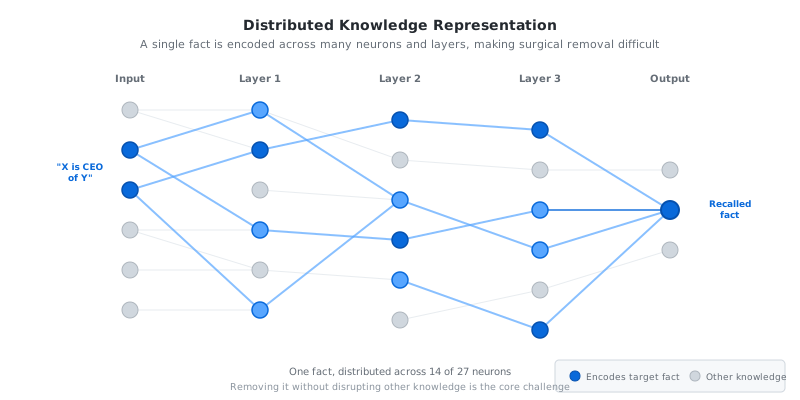
The fundamental issue is that neural networks don’t store facts in discrete locations. A single piece of knowledge (say, “X is the CEO of Y”) might be encoded through direct memorization in attention patterns, indirect associations (“X announced Y’s quarterly earnings”), reasoning chains that can reconstruct the fact, and even stylistic patterns in how the model discusses the company.
Suppressing the model’s ability to say “X is CEO of Y” doesn’t touch any of these indirect pathways. Someone with a clever prompt can often recover the information through a side channel.
This makes unlearning fundamentally different from deletion. You’re not removing a file. You’re trying to selectively ablate a distributed representation without knowing exactly where it lives.
The four scenarios driving demand
Privacy compliance is the most urgent. GDPR’s right to be forgotten assumes you can actually forget. When someone’s personal data was in a model’s training set, the legal expectation is removal, but the technical reality is murky. Can you even verify that all traces are gone? What if the model can reconstruct their information from other correlated examples?
Copyright disputes are a growing headache. If your model memorized passages from copyrighted books, rights holders want those passages unlearned. But the model didn’t just memorize text. It learned stylistic patterns, plot structures, conceptual relationships. Where exactly do you draw the line on “removed”?
Factual updates seem like they’d be easier. They aren’t. If a company has a new CEO, you can’t just tell the model. Adding new information doesn’t overwrite old information. The model ends up hedging between contradictory beliefs, and its confidence signals become unreliable.
Backdoor removal is the security angle. If an attacker poisoned your training data to embed a triggered behavior, you need to find and remove the association without damaging general capabilities, then verify it’s truly gone.
What people have tried
The most intuitive idea is fine-tuning the model on “forget” examples, training it to refuse or produce blank responses for targeted queries. It works on the surface. Underneath, the knowledge usually survives. An adversarial prompt can bypass the refusal and extract the original information. You’ve taught the model to lie about what it knows, not to actually forget it.
Gradient ascent takes the opposite approach: maximize the loss on the data you want forgotten, essentially running training in reverse.
\[\theta' = \theta + \alpha \nabla_\theta \mathcal{L}(\theta; D_{\text{forget}})\]Appealing math. Messy practice. The step size $\alpha$ is hard to get right: too small and nothing happens, too large and the model collapses. There’s no guarantee you’re only affecting the targeted knowledge. Neighboring information often gets caught in the blast radius.
Model editing approaches like ROME and MEMIT are more surgical. They locate the weight matrices storing specific factual associations and apply targeted rank-one updates. This works reasonably well for individual facts, but doesn’t scale to “forget this entire document.” And editing one fact can corrupt related knowledge in unexpected ways.
Influence functions try to compute how much each training example contributed to the model’s current state, then adjust as if those examples were never seen. Elegant in theory. Computing exact influence requires the Hessian matrix (second-order derivatives), which is computationally prohibitive at the scale of modern LLMs. The approximations introduce error, and the linearity assumption underlying the approach is often wrong.
The verification trap
Even if you successfully unlearn something, proving it is its own problem.
The simplest check, asking the model directly, is also the least reliable. The model might refuse to answer while still “knowing” the information internally. Indirect retrieval through rephrasing, context manipulation, or multi-step reasoning often recovers supposedly-deleted knowledge. Membership inference attacks offer statistical evidence: if the model assigns suspiciously low loss to “forgotten” examples, they’re probably still encoded.
Then there’s the meta-question that’s easy to overlook: did the unlearning break anything else? If you remove knowledge of a specific CEO and accidentally degrade the model’s general business reasoning, you haven’t solved the problem. You’ve traded one failure for another.
Where this is actually heading
The honest takeaway is that perfect surgical unlearning for large language models is somewhere between very hard and impossible with current techniques. The distributed nature of knowledge in neural networks isn’t a bug in our approach; it’s a fundamental property of how these models learn.
The strategies that work today are less elegant than the research papers suggest. For privacy compliance, periodic retraining with problematic data excluded is still the gold standard. For factual updates, retrieval augmentation sidesteps the problem by keeping updateable knowledge outside the model. For safety, defense in depth (unlearning plus output filtering plus monitoring) beats any single technique.
The more interesting long-term question might not be “how do we make models forget” but “how do we build models that support granular updates from the start.” Modular architectures with explicit knowledge layers. Audit trails for data provenance. Clean separation between parametric memory and retrieved knowledge.
We designed databases for easy deletion. We didn’t design neural networks that way. Maybe we should start.
This post draws on research from Google (influence functions), MIT (ROME/MEMIT model editing), and ongoing work across the ML safety community.