Beyond Accuracy: Evaluating Chain-of-Thought Reasoning in Production
I spent months benchmarking LLMs on RTL code generation at Harvard’s Edge Computing Lab and evaluating long-context reasoning at Georgia Tech’s FSI Lab. Over hundreds of evaluation runs, one pattern kept surfacing: a model could produce a beautifully coherent reasoning chain and still get the answer completely wrong.
This isn’t a failure of chain-of-thought prompting. It’s a measurement problem. Most evaluation frameworks check whether the model got the right answer. Almost none check whether it got there for the right reasons.
The example that changed how I think about evaluation
Here’s something I saw while benchmarking RTL code generation. The task: generate a 4-bit counter with asynchronous reset.
The model’s chain-of-thought was textbook. Use a 4-bit register, increment on each clock edge, handle async reset with an if statement, reset to 0000 when the reset signal goes high.
The generated code used synchronous reset.
Read the reasoning again. Every step is correct. The implementation contradicts step 3. And if you’re only checking whether the counter works, well, synchronous reset can pass many of the same testbenches. You might not catch the bug unless you specifically test the async behavior.
This is the core problem. Fluency is not correctness. A plausible reasoning chain is not evidence of sound reasoning.
An evaluation hierarchy born from frustration
Through 150+ RTL generation tasks, I built up a layered evaluation approach out of necessity. Each level catches failures the levels below it miss.
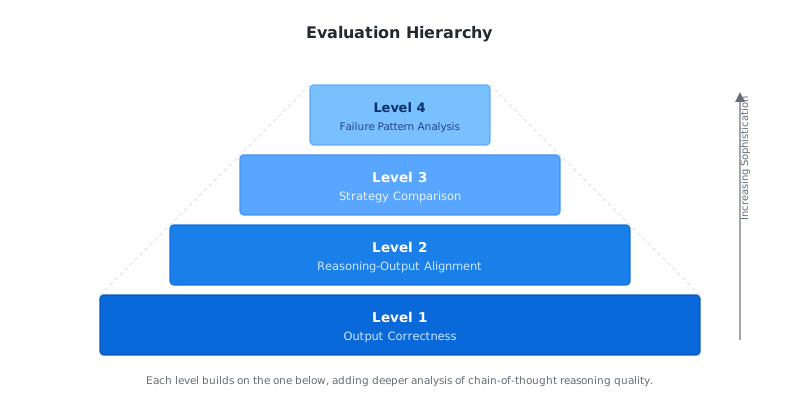
Level 1 is output correctness. Does the code compile? Does it pass testbenches? Does it meet performance targets? This is table stakes and what most benchmarks stop at.
Level 2 checks whether the code matches the reasoning. Did the model actually implement what it described? This catches post-hoc rationalization, where models claim they used a lookup table for efficiency and then write a case statement instead. It happens more often than you’d expect.
Level 3 compares prompting strategies head-to-head. We tested zero-shot, few-shot, chain-of-thought, and CoT with re-prompting. The results weren’t what I expected: plain CoT hit a 53% testbench pass rate, while CoT with re-prompting reached 61%. The gap isn’t huge, but the quality of failures changed. Models with explicit reasoning chains were 2.4x more likely to successfully fix their code when we fed error messages back to them. The chain gives the model a map of what it was trying to do, which makes error feedback actionable. Without it, re-prompting is just “try again.”
Level 4 is understanding how reasoning breaks. Four failure patterns kept recurring. Specification gaps: the model fills in ambiguous requirements incorrectly, like defaulting to synchronous reset when the spec says asynchronous. Complexity collapse: satisfying three out of five constraints and quietly ignoring the others. Template overfitting: a standard counter works, but adding an enable signal breaks everything because the model is matching a pattern, not understanding the circuit. And logical inconsistency: the chain contradicts itself, like using blocking assignments for sequential logic.
Long-context makes everything harder
At Georgia Tech, we worked with 170 financial credit agreements and 20,139 multi-hop QA pairs. The reasoning challenge was fundamentally different from code generation: answers required synthesizing scattered information across long documents.
A typical question: “If Company A’s credit agreement allows a 2.5x debt-to-EBITDA ratio, and their covenant states a minimum EBITDA of $50M, and Section 7.3 limits total debt to $150M, what is the maximum additional debt they can take on?”
Answering correctly means extracting facts from different sections, recognizing that multiple constraints apply, and selecting the binding one. Models frequently got all the facts right and then applied only one constraint, ignoring the rest. The reasoning chain looked thorough. The answer was wrong.
Two things moved the needle. Forcing models to cite specific document sections reduced hallucination, because it’s harder to fabricate a fact when you have to point to where you found it. And chunking strategy mattered more than I expected: models that could see all relevant constraints simultaneously performed significantly better than those synthesizing across chunks.
The measurement paradox
Here’s something uncomfortable: better evaluation makes your numbers go down.
When we improved testbench coverage for RTL generation, the success rate dropped from 61% to 53%. But the code that survived the harder tests was genuinely better, with fewer edge-case bugs and more robust timing behavior. The earlier metrics were inflated by surface-level checks that missed real problems.
If your evaluation metrics keep improving without changes to the model or prompts, be suspicious. You might be measuring the easy parts and ignoring everything else.
What actually moved the needle
After over a thousand evaluations, a few prompting patterns consistently improved reasoning quality.
Explicit constraint enumeration (“list all requirements before you start solving”) reduced specification gaps. Self-verification steps (“check whether your solution satisfies each requirement”) caught complexity collapse. Structured output formats gave the model scaffolding for its reasoning. Error-aware re-prompting with specific failure feedback was the single biggest improvement for iterative workflows.
Some intuitions didn’t hold up. Longer reasoning chains didn’t improve accuracy; verbosity isn’t rigor. Temperature tuning didn’t fix systematic errors. Few-shot examples too similar to the test case caused the model to match surface patterns rather than learn the reasoning.
The uncomfortable bottom line
Chain-of-thought prompting is genuinely useful. It enables iterative debugging, provides audit trails, and improves accuracy on multi-step problems.
But it’s not a substitute for rigorous evaluation. The same model that explains quantum mechanics in accessible prose can generate a broken circuit with an impeccable-sounding justification.
If you’re using CoT in production: verify outputs independently. Build automated checks wherever possible. Track reasoning-output alignment, not just correctness. And remember that sometimes a correct answer with no reasoning chain beats a wrong answer with a beautiful one.
Robust reasoning matters more than occasional correctness. And measuring reasoning is harder than measuring answers.
This post draws from benchmarking work at Harvard University’s Edge Computing Lab (RTL code generation) and Georgia Tech’s FSI Lab (long-context evaluation).